
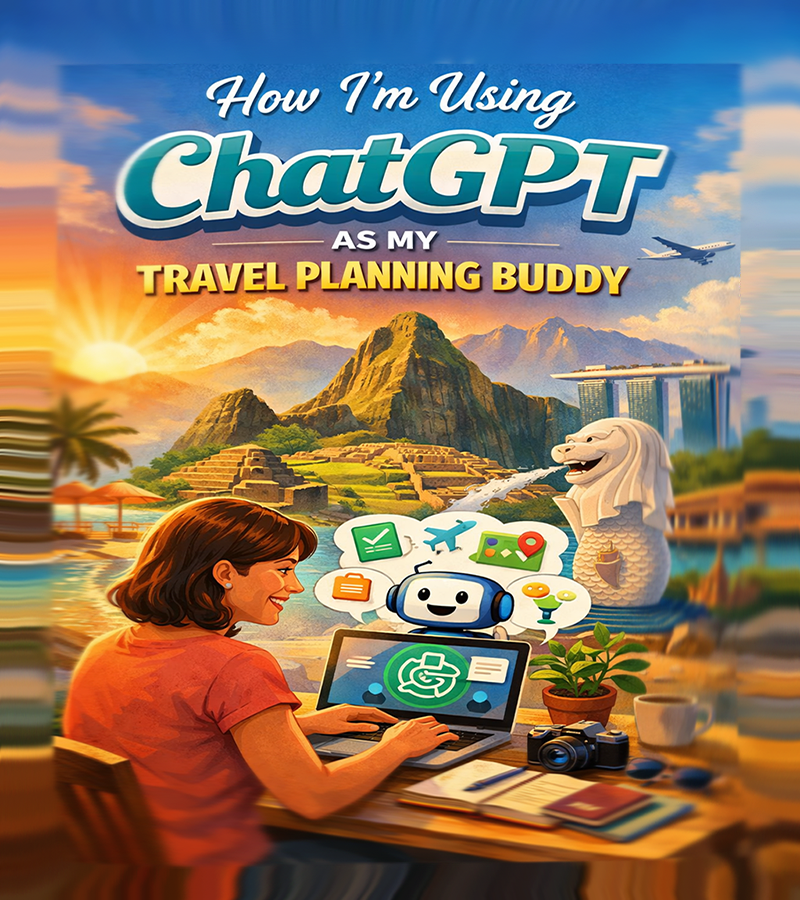
How I’m Using ChatGPT as My New Travel Planning Buddy (and Having Way Too Much Fun Doing It)
I do love travel planning. It feels like part of the trip to me; the dreaming, the researching, the “what if we added one more stop?” moments. But let’s be honest: it can also be time consuming and tiring. Between juggling logistics, comparing options, and trying to build something that actually fits how I like to travel, planning can start to feel like work.
That’s where ChatGPT came in. What started as a curiosity has quietly turned into my favourite travel planning tool; and, surprisingly, one of the most enjoyable parts of dreaming about and getting ready for a trip.
Instead of fighting spreadsheets and browser tabs (OK, I confess, I actually like that stuff sometimes, but even I have my limits!), I now plan trips through an ongoing conversation. And the more I use it, the better it gets at planning like I would.
From Loose Ideas to Real Trips
I rarely start with a fully formed plan. Usually it’s something vague like:
“We want culture, great food, and not too much rushing.”
With ChatGPT, I can stay vague at first. I’ll ask things like:
- What is a good time of year to go?
- How do these two hotels compare?
- How far is this area from the main sights?
That’s exactly how I approached planning a Singapore trip in late 2025. I didn’t want a hyper-packed itinerary or a generic “top 10 attractions” list. I asked for recommendations based on a specific traveller profile: experienced mature traveller, food-focused, culture-curious, happy to walk a lot but not an athlete, and more interested in neighbourhoods than checklists.
The result wasn’t just a list of things to do — it was a plan that felt right. Hawker centres over fine dining splurges every night. Time built in to explore on foot. A realistic pace that acknowledged jet lag without wasting days. It even factored in when I might want an easier morning versus a longer wandering afternoon, which is exactly how I travel but don’t always articulate clearly upfront.
Turning Bookings Into a Thoughtful Itinerary
Once flights and hotels are booked, ChatGPT really shines. I’ll paste in my booked arrival times, check-in details, and departure flights, then ask for a day-by-day itinerary that balances structure with flexibility.
For a beach-focused trip in Colombia, I asked for excursion ideas but made it clear I wanted plenty of time to relax. It suggested activities, spaced them out properly, and left room for beach and pool time. When I later decided I wanted a volcanic mud experience, I didn’t need to rework everything, I just asked to add it. It all slotted in seamlessly.
For my upcoming trip to Ecuador, it made genuinely helpful recommendations on layover times based on my transfer airport, connection risks, and likely transit times to clear customs. It flagged where a tight connection might technically work on paper but feel stressful in reality, and where a longer layover would give me breathing room without wasting half a day. That kind of advice is hard to get from booking engines, but incredibly valuable when comfort and sanity matter as much as efficiency.
Peru: Where Iteration Really Paid Off
Peru planning was a great example of where ChatGPT truly earned its place in my workflow.
I started with a complex, multi-week itinerary that I had worked on a few years back, but the trip never happened (spring of 2020 was the plan – anyone remember 2020 and travel plans? LOL). I asked ChatGPT to:
- Put everything into a clean table
- Export it into a PDF
- Add Huacachina
- Add a 3-day Amazon rainforest stay from Puerto Maldonado
- Extend the trip instead of cutting anything (I’m retired, I have time and don’t need to rush!)
- Then layer in rough price estimates for activities
Normally, that kind of revision would mean starting over or spending hours reformatting. Instead, it became an ongoing conversation:
“What about the Tucume pyramids?”
“Don’t remove anything — just extend the trip.”
“Update the PDF with the new sections.”
It made practical recommendations on what to include, how to work it in easily, and what is best left out or saved for a separate trip. Each change built on the last. No chaos. No version confusion. Just a steadily improving plan that felt thoughtful instead of bloated.
Planning Based on How I Travel
One of my favourite things about using ChatGPT is how personal the planning has become.
I regularly ask for recommendations based on traveller profile — not just gender, age, or budget, but style. Over time, ChatGPT has picked up on my personal patterns:
- I like a balanced pace, not overpacked days
- I value unique experiences over ticking boxes
- I care about logistics and flow
- I want downtime baked in, not treated as an afterthought
- I’m willing to pay for value and don’t want to pinch pennies and sacrifice comfort (I don’t usually go for supreme luxury, but I’m willing to spend a bit more for comfort)
Now, it often anticipates those preferences without me spelling them out every time. It suggests pacing that makes sense. It avoids overly aggressive schedules. It flags when a plan might feel rushed. It considers my comfort level within my budget range.
That continuity is something you just don’t get from search engines.
Making Plans That Are Easy to Share
Another underrated benefit: presentation.
I’ve used ChatGPT to turn messy notes into clean tables, polished PDFs, and clear summaries I can send to travel companions. Instead of forwarding a jumble of links and thoughts, I can share something that actually looks intentional.
I can feed it everyone’s preferences, and it works it all out without the stress of me firuging out how to balance everyone’s diverse interests: J wants birdwatching, T wants a spa, S wants a museum, R wants a food experience, I want a cultural event; T and I want a shopping day; J and S want a hike; R wants to rest.
That alone has reduced stress and friction in group travel planning. I get fewer back-and-forth questions, fewer misunderstandings, and a lot more “this looks great” responses.
Beyond Itineraries
I’ve also used ChatGPT for the more analytical side of travel, like comparing airline loyalty programs and analyzing rule changes. One particularly useful exercise was feeding in my past Air Canada travel patterns and asking it to calculate how different booking and credit card strategies would affect my path to Super Elite status under the new Aeroplan rules that came into effect in 2026.
It helped me break down historical data, compare old versus new qualification rules, and clearly see whether changes actually made me better or worse off. More importantly, it helped me explain those findings clearly; both to myself and later in writing.
I’ve even used it to help rewrite dense, technical explanations into blog-ready posts. I still go in and do my own revisions — I am a writer at heart, and I need to leave my mark — but it dramatically speeds up the process.
And yes, I’ve told it things like, “Use proper Canadian spelling” and “watch it with the excessive em dashes and bold characters” and it listens (well… mostly listens. My inner editor is still alive and kicking and I will never put down my metaphorical red pen. For crying out loud! I‘m still removing em dashes and inserting semi-colons. Who doesn’t love a good semi-colon????… ok rant over).
Why This Is More Fun Than Google
Google gives you information.
ChatGPT gives you collaboration.
It remembers what you’ve already decided. It adapts when plans change. It helps you reason through trade-offs instead of just listing options.
Most importantly, it removes friction. When planning stops feeling heavy, you explore more ideas. You refine instead of rushing. You end up with trips that feel more aligned with how you actually like to travel.
The Best Part: I’m Genuinely Enjoying This
I catch myself opening ChatGPT not because I need to plan, but because I want to.
- “What if we added one more stop?”
- “How could we slow this down?”
- “What’s a more local experience here?”
- “Based on where I’ve already been, where should I go in 2026?”
Travel planning has become part of the excitement again instead of something to just get through.
For me, ChatGPT isn’t just a tool. It’s my new travel planning buddy that’s getting better at understanding me every time we plan a trip together. And honestly, I’m having a lot of fun with it.